Our verdict
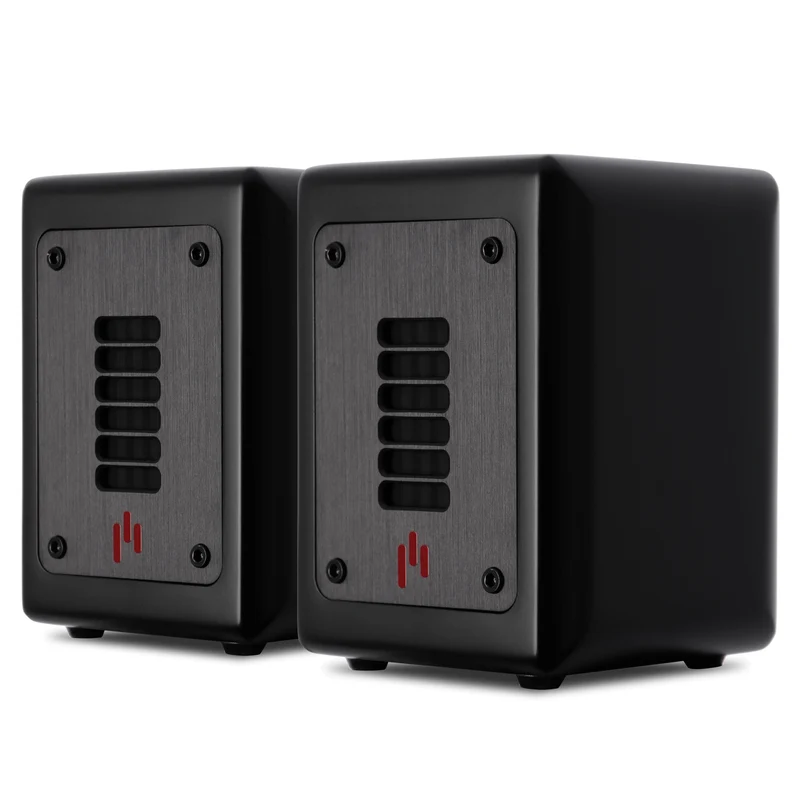
The PST is the most affordable way into Aperion's popular super tweeter line, and it is easy to recommend. A planar-magnetic ribbon driver, five crossover points and a treble trim make it simple to blend with most bookshelf or tower speakers that have 85–94 dB sensitivity. Owners rate it 4.9/5, and a 30-day in-home audition lets you try it with your own system (returns carry a 10% restocking fee).
Pros & cons
Pros
- Planar-magnetic ribbon driver extends response to 40 kHz
- 5 crossover points (8–16 kHz) plus an OFF switch for easy blending
- Treble trim down to −5 dB to tame bright rooms or speakers
- Connects to your existing speaker terminals, no extra amplifier needed
- 30-day in-home audition, free shipping in the continental U.S. and a 3-year warranty
Cons
- Best matched to speakers rated 85–94 dB; very efficient speakers need Aperion's HST instead
- Improvement is subtle on bright speakers or systems that already use ribbon/AMT tweeters
- Adds an extra box on top of each speaker
Overview
If your speakers sound a little closed-in or dull at the top end, replacing them is the expensive fix. A super tweeter is the cheap one. Aperion Audio, an Oregon-based direct-to-consumer speaker brand founded in 1998, has built a following around its super tweeter add-ons. The PST Planar-Magnetic Ribbon Super Tweeter is the entry point to that range and currently Aperion's best-selling product.
This review draws on Aperion's published specifications and manual, the design of the driver and crossover, and feedback from verified owners (the PST holds a 4.9/5 rating from 145 reviews on Aperion's site at the time of writing).
What is a super tweeter?
A super tweeter is an extra high-frequency speaker that sits on top of your existing bookshelf or tower speakers. Many speakers roll off or narrow their dispersion in the highest octaves. A super tweeter takes over in that range to add what listeners usually call "air": more space around instruments, crisper cymbals and a wider, deeper soundstage.
The PST works from 8 kHz up to 40 kHz, well beyond the roughly 20 kHz limit of a typical tweeter. Most of the audible benefit comes from the overlap region you choose with the crossover, where the ribbon adds detail and wider dispersion to what your speaker already plays.
Design and build quality
The PST uses a planar-magnetic "flat ribbon" driver: a thin Kapton film with an aluminium conductor pattern, suspended in a magnetic field. Ribbon drivers are prized for their low moving mass, which lets them respond quickly and sound detailed and smooth.
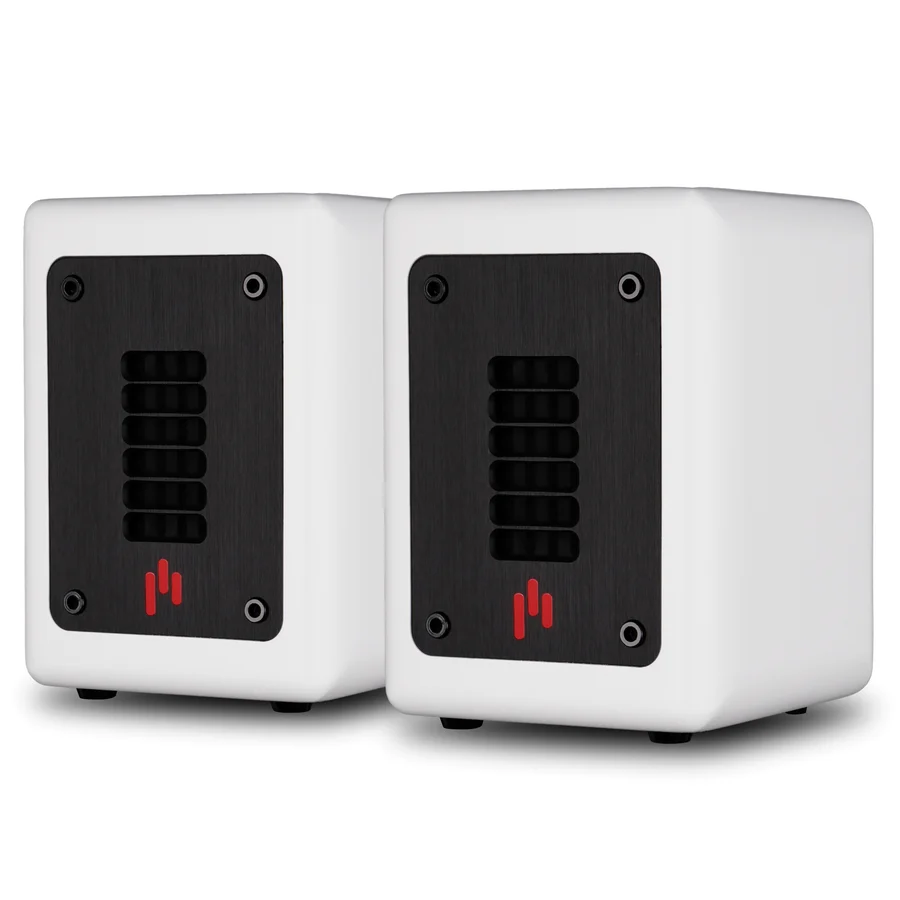
The crossover uses non-inductive resistors and film capacitors, and Aperion designs it for a linear phase response to keep timing coherent with your main speakers. Each unit sits in a compact, curved cabinet (about 4 × 5.3 × 5 inches) with 5-way gold-plated binding posts, available in Gloss Black, Pure White, Stealth Black or Gloss Cherry.
Setup and adjustability
Setup is the PST's biggest strength. There is no extra amplifier and no complicated wiring: you connect it in parallel to the same terminals as your speaker, and it draws from the power already going to that speaker.
Two controls on the back let you tune the blend:
- Crossover: 8, 10, 12, 14 or 16 kHz, or OFF. Lower settings overlap more with your existing tweeter for a more obvious effect; higher settings add only the very top end.
- Treble adjust: 0 to −5 dB, to keep things balanced with bright speakers or reflective rooms.
Tip: Start at 14 kHz with the treble at −2 dB, then move one step at a time. If the sound becomes sharp or fatiguing, raise the crossover point or lower the level. The best setting is usually the one where you miss it when you switch it OFF, rather than one where you obviously hear it.
The PST is designed for main speakers with 85–94 dB sensitivity, which covers the majority of home bookshelf and tower speakers. Check your speaker's spec sheet before ordering.
Sound: what to expect
With a good match, owners consistently report a more open, spacious presentation: clearer cymbals and strings, more precise imaging and a soundstage that extends beyond the speakers. Vinyl, SACD, FLAC and hi-res streaming listeners tend to get the most out of it.
It is worth keeping expectations realistic. A super tweeter refines a system rather than transforming it. If your speakers already use a ribbon or AMT tweeter, or are voiced on the bright side, the improvement will be smaller. That is why the in-home audition matters.
Who should buy the Aperion PST?
Buy it if:
- You like your speakers but want more detail and air without replacing them.
- You listen to vinyl or hi-res music on a stereo or home theater system.
- You want to try a super tweeter without spending $650–$1,000.
Skip it if:
- Your speakers are very efficient (98 dB and above). Aperion's HST is built for those.
- You have a large room or high-end system and want maximum output, in which case the RST ($649) or dual-firing DST ($999) are better fits.
Price, warranty and buying from Aperion
The PST costs $399 per pair ($419 in Gloss Cherry) and is sold directly by Aperion Audio. Buying direct includes:
- 30-day in-home audition to test it with your own system (a 10% restocking fee applies if you return it)
- Free shipping in the continental U.S.
- 3-year warranty with lifetime customer support
- Optional pay-over-time financing with Affirm
The bottom line
The Aperion PST is one of the simplest, most affordable ways to get more detail and space out of the speakers you already own. It is well built, very easy to tune, and backed by strong owner reviews and a risk-free trial. For most bookshelf and tower speaker owners curious about super tweeters, this is the one to start with.
Specifications
| Driver | Planar-magnetic flat ribbon (Kapton film, aluminium conductors) |
|---|---|
| Frequency response | 8 kHz – 40 kHz |
| Impedance | 6 Ω |
| Sensitivity | 94 dB |
| Crossover points | 8, 10, 12, 14, 16 kHz & OFF (12 dB/octave) |
| Treble adjust | 0 to −5 dB in 1 dB steps |
| Recommended power | 10–100 W |
| Matching speaker sensitivity | 85–94 dB |
| Dimensions (each) | 4 × 5.3 × 5 in (102 × 134 × 127 mm) |
| Weight (each) | 1.7 lb (0.75 kg) |
| Finishes | Gloss Black, Pure White, Stealth Black, Gloss Cherry |
| Warranty | 3 years + lifetime support |