Our verdict
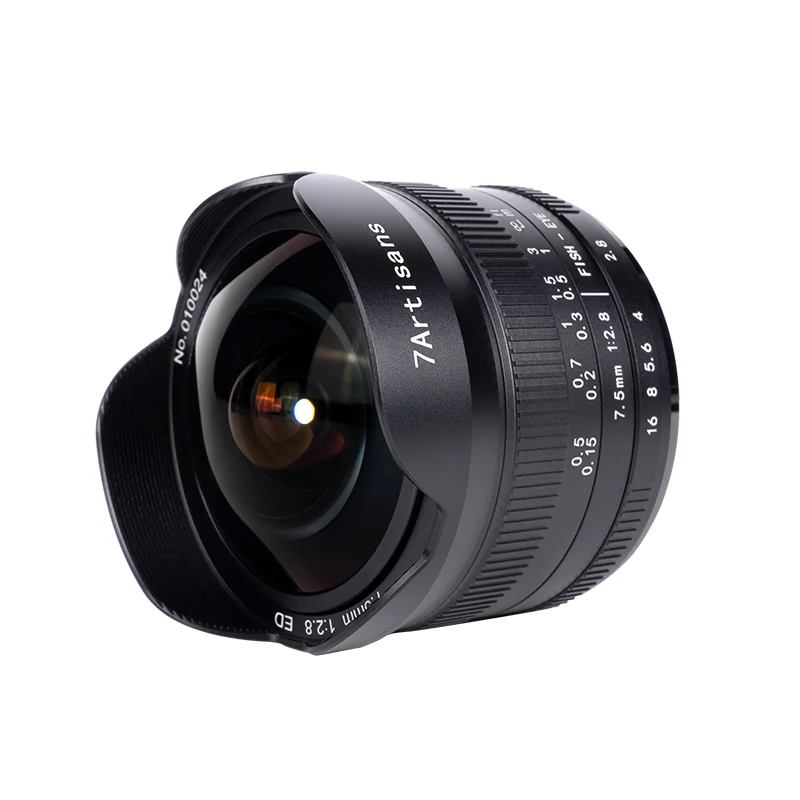
The 7Artisans 7.5mm f/2.8 Mark II is the easiest way to add a true fisheye look to an APS-C or Micro Four Thirds mirrorless camera. You get a 190° field of view, a bright f/2.8 aperture, ED glass and an all-metal body for around $120. It is fully manual, but the huge depth of field makes focusing simple. If you want dramatic perspectives without spending hundreds, this is the one to buy.
Pros & cons
Pros
- Extreme 190° field of view for dramatic, immersive images
- Bright f/2.8 aperture works well for night skies and low light
- Mark II optics: Hoya glass plus 2 ED elements to reduce edge color fringing
- Solid metal build yet only about 265 g
- Very affordable, around $118 on sale
- Available for Sony E, Fuji X, Nikon Z, Canon RF, Canon EF-M and Micro Four Thirds
Cons
- Manual focus and manual aperture only, with no EXIF data
- Built-in petal hood means no standard screw-in filters
- Strong fisheye distortion is a creative effect, not for everyday shooting
- 14-day return window and a 1-year warranty are shorter than big-name brands
Overview
A fisheye lens is one of the most fun ways to change how your photos look. It bends straight lines into sweeping curves and squeezes an almost impossible amount of the scene into one frame. The problem is that most fisheye lenses from big camera brands cost several hundred dollars.
The 7Artisans 7.5mm f/2.8 Mark II fixes that. It is currently 7Artisans' best-selling product, and it is easy to see why: a 190° field of view, an f/2.8 aperture, upgraded ED optics and a metal body for around $118.
This review is based on the official specifications, the lens design and its features compared with other options in the category.
Design and build quality
The Mark II is built almost entirely from metal and feels far more premium than its price suggests. At about 265 g, it is still small and light enough to leave on your camera all day or pack for travel.
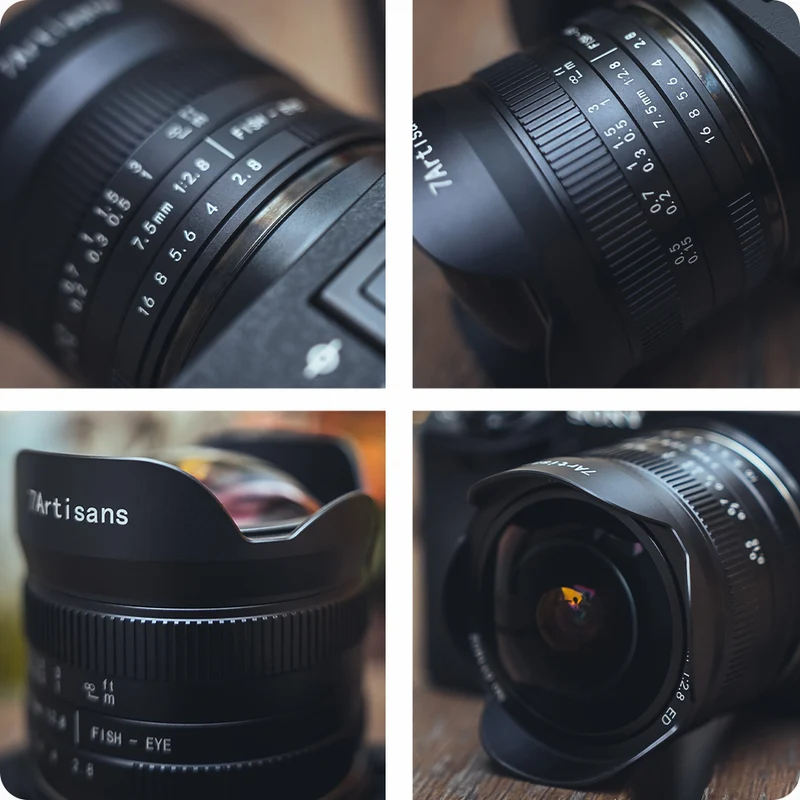
The aperture ring is de-clicked, so it turns smoothly and silently. That is a real advantage for video, because you can change exposure mid-shot without a click or a sudden jump. A distance scale on the focus ring helps you set focus quickly without looking through the viewfinder.
The front has a built-in petal hood that protects the bulging front element. The trade-off is that you cannot attach standard screw-in filters.
Image quality
The Mark II brings two meaningful optical upgrades over the original:
- New Hoya glass for better clarity and contrast.
- Two ED (extra-low dispersion) elements that reduce color fringing toward the edges, the area where cheap fisheye lenses usually struggle most.
The optical design uses 11 elements in 9 groups. As with most budget ultra-wide lenses, you can expect the center to be sharpest and the extreme edges to be softer wide open, and stopping down to around f/5.6–f/8 is the usual way to get the most even results.
The f/2.8 maximum aperture is a big plus for night photography. Combined with the super-wide view, it lets you capture the Milky Way, star trails or auroras with shorter exposures and less noise.
Using a manual fisheye
Manual focus sounds intimidating, but a 7.5 mm fisheye is one of the easiest lenses to focus manually. The depth of field is enormous: set focus just short of infinity, choose f/5.6 or f/8, and almost everything from near to far will be sharp.
Tip: Turn on focus peaking and magnification for close-up creative shots. The lens focuses down to just 15 cm, which lets you get dramatically close to your subject.
Because the lens has no electronic contacts, your camera will not record aperture data, and you need to enable your camera's "Release shutter without lens" setting the first time you use it.
What it is best for
- Creative and street photography: exaggerated perspectives and curved horizons that grab attention.
- Action and skate videos: the classic fisheye look, up close.
- Astrophotography and landscapes: a huge slice of sky in a single frame at f/2.8.
- Architecture and interiors: capture an entire room or building when you cannot step back.
- Pets and portraits: playful, funny close-ups with big noses and wide backgrounds.
Compatibility
The lens is designed for APS-C sensors and is available for Sony E (a6000 series, ZV-E10, FX30), Fujifilm X, Nikon Z (Z50, Zfc, Z30), Canon RF (R7, R10, R50, R100), Canon EF-M and Micro Four Thirds (Panasonic and Olympus/OM System). Choose the correct mount when ordering. On Micro Four Thirds the smaller sensor gives a slightly narrower field of view.
Price, shipping and returns
At around $118 on sale (regular price $139), the Mark II is one of the cheapest ways to get a real fisheye. Buying direct from the official 7Artisans store gets you:
- Local warehouses in the US, EU and Brazil, with duties and taxes already included for those regions.
- Free shipping on orders over $150. The lens alone falls just under the threshold.
- A 1-year warranty and a 14-day return window for unused items. Non-defective returns carry a 5% handling fee, so make sure you choose the right mount.
Who should buy it?
Buy it if:
- You shoot with an APS-C or Micro Four Thirds mirrorless camera and want a creative ultra-wide look.
- You love night skies, action video or dramatic travel shots.
- You want a quality fisheye without spending $300 or more.
Skip it if:
- You need autofocus or full electronic communication with your camera.
- You want a rectilinear ultra-wide lens with straight lines. Look at a regular wide-angle lens instead.
- You shoot on a full-frame camera without crop mode.
The bottom line
The 7Artisans 7.5mm f/2.8 Mark II delivers the fun and drama of a true fisheye at a price that makes it an easy impulse buy. Its metal build, bright aperture and improved ED optics put it well above what you would expect for the money. Just be comfortable with manual control and pick the right mount.
Specifications
| Focal length | 7.5 mm (≈11 mm full-frame equivalent on APS-C) |
|---|---|
| Maximum aperture | f/2.8 |
| Minimum aperture | f/16 |
| Angle of view | 190° |
| Optical design | 11 elements in 9 groups (2 ED, Hoya glass) |
| Aperture blades | 5 |
| Aperture ring | De-clicked (smooth, silent) |
| Focus | Manual |
| Closest focus | 0.15 m (5.9 in) |
| Image stabilization | None |
| Body | Metal |
| Weight | About 265 g (9.3 oz) |
| Sensor format | APS-C |
| Mounts | Sony E, Fuji X, Nikon Z, Canon RF, Canon EF-M, Micro Four Thirds |
| Warranty | 1 year |